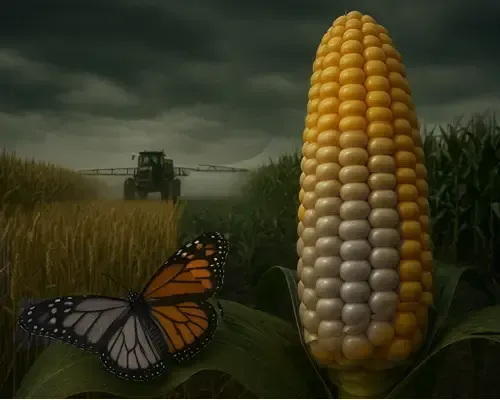
When Genetic Modification Goes Wrong: Overseas Lessons NZ Should Not Ignore
Genetic modification is sometimes promoted as modern, precise, and 'necessary', in case 'NZ gets behind the times!' As a country known for its pioneering success, it is easy to see why we need to protect our GE-free status and not be taken advantage of.
It is possible that companies seeking to cash in on patents or natural resources could take advantage of New Zealand's GE-free status, without care for the consequences.
But overseas experience tells us to be highly cautious. Around the world, (much larger) countries have restricted, banned, or reversed the cultivation of genetically modified crops due to concerns about contamination, biodiversity loss, chemical dependence, trade disruption, and harm to farmers.
Why Organic and GE Cannot Coexist in NZ
Mexico is one of the clearest examples. In March 2025, Mexico adopted a constitutional amendment banning the domestic cultivation of genetically modified corn, recognising Mexico as a centre of origin and diversity for maize and prioritising the protection of native varieties. This matters because once GE crops enter open agricultural systems, pollen drift, seed movement and supply-chain mixing make full containment extremely difficult. In a small, export-focused country like NZ, genuine coexistence between organic and GE systems is effectively impossible once contamination pathways are considered.
Organic producers and consumers understand that even small levels of contamination can threaten certification, export trust and long-term biodiversity. Organic producers and consumers know that GE is the enemy of nature. If GE pollen or seed contamination enters organic crops, those crops can lose organic certification and international market value. Once contamination spreads, it cannot simply be undone.
Did you know that New Zealand's organic sector has reached a record NZ$1.18 billion in value.
So what if you don't know much about organic farming and you are trying to figure out why changing New Zealand's GE status is beyond repair if the Gene Technology Bill proceeds in NZ rather than being scrapped?
Check out these overseas facts:
Mexico's position was not just symbolic. Researchers have found evidence of transgenes in Mexican maize landraces, warning that GMO planting in the crop centres of origin creates risks of unintended gene flow into traditional varieties. For a country whose food culture, seed heritage and biodiversity are built around corn, this is a serious warning.
Peru has also taken a precautionary approach. Its GMO moratorium was extended until 2035, restricting the import and production of GMOs for environmental release. The European Union also allows member states to restrict or prohibit GMO cultivation, and the European Commission lists many countries and regions that have requested geographical restrictions.
The contamination record is equally concerning. In the United States, StarLink corn was approved only for animal feed, not for human food, due to concerns about allergenicity. Yet in 2000, it was found in the human food supply, triggering major recalls and exposing the weakness of "controlled use" promises.
A similar problem occurred with LibertyLink LL601 rice. In 2006, unapproved genetically modified rice was detected in US rice stocks, causing trade disruption, especially with the European Union. These cases show that even when a GE crop is not meant for a particular market or food stream, contamination still happens.
Burkina Faso provides another warning. Bt cotton was promoted as a success, but the country later phased it out after cotton quality problems damaged its export value. A research review of the Bt cotton "success narrative" found that quality and yield issues challenged the claims made for the technology.
Herbicide-resistant GE crops have also driven a chemical treadmill. A major review found that herbicide-resistant crops affect weed management and contribute to biodiversity loss in several ways. Another study found that GE herbicide-resistant crops are associated with the evolution of herbicide-resistant weeds in the United States.
These overseas examples are highly relevant to NZ. Once GE crops are released outdoors, the risks are not confined to a laboratory. They involve farms, neighbouring land, seed systems, export markets, food processors, organic growers and public trust.
NZ does not need to repeat the mistakes seen overseas. Mexico, Peru and many European countries show that precaution is not anti-science. It is a responsible response to real-world evidence: contamination happens, resistance develops, promised benefits fail, and traditional food systems can be placed at risk.
A safer food future requires strong regulation, full traceability, liability for contamination, and protection for non-GE and organic producers. The international record shows that weakening gene technology safeguards would not reduce risk. It would move the risk onto farmers, consumers, ecosystems and future generations. But it is not about risk - there is enough information to know that losing New Zealand's GE-free status is not reasonable.
Pesticide-resistant crops mean even more sprays, such as glyphosate (weed killer), are used. The Gene Technology Bill proposes the development of pesticide-resistant crops. Who is this benefiting? Not New Zealanders.
More than 100,000 plaintiffs in the US have filed claims alleging Roundup (containing glyphosate) caused cancer.
Some reports now place the total number of claims at around 170,000.
Bayer has reportedly paid more than US$11 billion in settlements and jury awards related to Roundup litigation.
Bayer announced a further proposed US$7.25 billion settlement in 2026 aimed at resolving tens of thousands of current and future claims.
Reuters reported that Bayer has already allocated around US$16 billion toward Roundup litigation overall.
Examples of verdicts and awards include:
- A Missouri plaintiff, John Durnell, was awarded US$1.25 million after alleging Roundup exposure caused non-Hodgkin lymphoma.
- Four plaintiffs in Missouri were awarded US$611 million in a Roundup cancer verdict.
The disease most commonly referenced in the litigation is non-Hodgkin lymphoma, although lawsuits and legal sites also reference:
- B-cell lymphoma
- Multiple myeloma
- Leukemia variants
- But it does not stop there - pesticide/herbicide use is seriously linked to all sorts of issues >Read More.
Allergens
In the early 1990s, researchers at the University of Nebraska inserted a gene from the Brazil nut into soybeans to enhance their methionine content, an essential amino acid. However, the modified soybeans expressed a protein that was a known allergen in Brazil nuts. When tested, individuals with Brazil nut allergies experienced allergic reactions upon exposure to the GM soybeans. This led to the termination of the project, demonstrating the potential for unintended allergenicity in GM foods. Read More
Many countries have said no to GE
For example, the Peruvian Congress has renewed its ban on genetically modified organisms (GMOs) until December 21st, 2035
Countries that have banned or reduced GE and Glyphosate:
References:
OANZ market report
https://www.oanz.org/nzmarket-report-2025
Mexico's constitutional GMO corn ban
Mexico transgene contamination study
https://pmc.ncbi.nlm.nih.gov/articles/PMC3001031/
https://gm.agbioinvestor.com/news/peru-extends-gmo-moratorium-by-15-years
European Union GMO cultivation restrictions
https://ccr.ucdavis.edu/biotechnology/starlink-corn-what-happened
https://en.wikipedia.org/wiki/StarLink_corn_recall
LibertyLink LL601 rice contamination study
https://ageconsearch.umn.edu/record/57154/files/jaae255.pdf
Burkina Faso Bt cotton failure study
https://www.sciencedirect.com/science/article/am/pii/S0305750X20302540
Herbicide-resistant crops and biodiversity review
https://pmc.ncbi.nlm.nih.gov/articles/PMC5250645/
Herbicide-resistant weed evolution study
Monsanto/Bayer Roundup lawsuit overview
https://www.sokolovelaw.com/product-liability/monsanto-roundup/
Reuters on Bayer Roundup litigation
Reuters on Bayer settlement proposal
AP News on Bayer litigation costs
https://apnews.com/article/c08ef6e35ccc166a4793dd76748ccce2