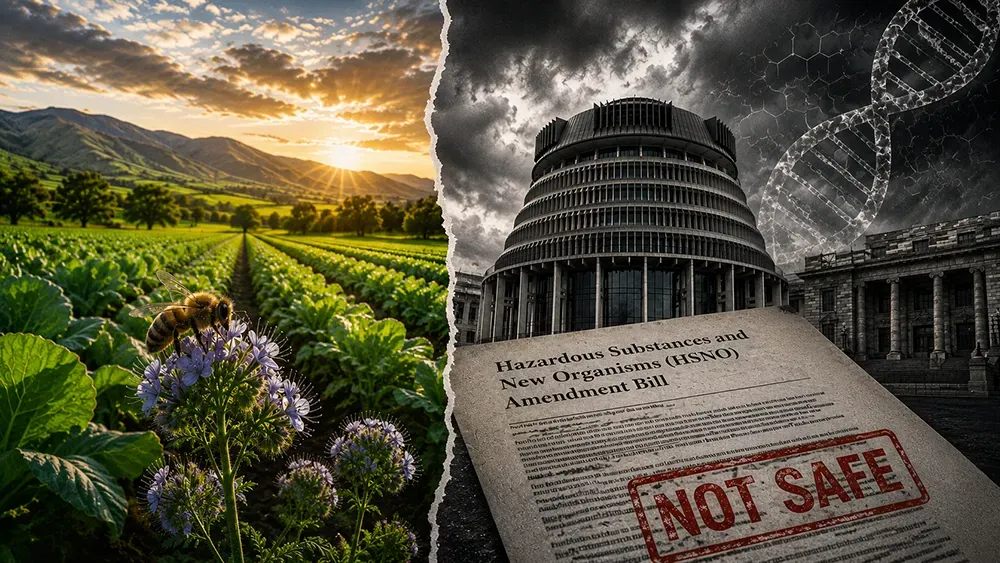
The Full Bill: https://www.legislation.govt.nz/bill/government/2026/304/en/latest/#LMS1596371
➜ Submission Page:
https://www3.parliament.nz/en/pb/sc/make-a-submission/document/54SCPRIP_SCF_910A20F8-AFC6-40BB-DD16-08DEAEFC95CF/hazardous-substances-and-new-organisms-amendment-bill
Deadline is: June 15th, 2026
The Hazardous Substances and New Organisms Amendment Bill
-SUMMARY-
Please read and summarise the bill for yourself. The summary below is intended as a general overview and is hoped to be accurate, it is appears ithe bill's intent is to distract from its agenda to allow NZ's GE status to change - which research shows would be harmful to health.
A suggested letter template is
➜
here
although submissions are closed it has useful info if you want to repeat email your MP
Overall Direction of the Bill
The bill reforms the approval and regulation system for:
- hazardous substances,
- agricultural chemicals,
- genetically modified organisms (GMOs),
- new organisms,
- agricultural and horticultural products,
- and biosecurity-related organism releases.
The overall direction is toward:
- faster approvals,
- more “risk-proportionate” regulation,
- greater use of rapid assessments,
- increased reliance on overseas regulators,
- more delegated decision-making,
- and expanded pathways for temporary or conditional approvals.
The bill repeatedly references improving “efficiency”, “streamlining”, “light-touch pathways”, and reducing regulatory barriers.
Main Issues Relevant to GMOs, Agriculture, Chemicals & Organics
1. Expansion of Faster / “Light-Touch” Approval Pathways
The bill explicitly expands:
- “light-touch approval pathways”
- rapid assessments
- temporary approvals
- reliance on overseas regulators.
This is significant because it applies to:
- hazardous substances,
- agricultural chemicals,
- and some new organisms.
Potential implications:
- agricultural chemicals may receive faster approval,
- less scrutiny may occur before approval,
- approvals may increasingly rely on overseas assessments rather than NZ-specific environmental conditions.
2. Increased Reliance on International Regulators
The bill would:
- “enable greater reliance on assessments relating to hazardous substances that are undertaken by recognised international regulators”
This may affect:
- pesticides,
- herbicides,
- fungicides,
- agricultural compounds,
- and possibly biotechnology products.
This means NZ regulators could rely more heavily on overseas decisions rather than conducting full independent NZ assessments.
3. Temporary Approvals for Hazardous Substances
- A major change is creation of:
- “temporary hazardous substance approvals”
- A hazardous substance may receive temporary approval if:
- a full approval application is still pending, and the product is already authorised by at least 2 international regulators.
Temporary approvals may last:
up to 4 years.
This is highly relevant to:
- pesticides,
- herbicides,
- agricultural sprays,
- chemical treatments.
Potential implication:
substances may be used commercially in NZ before the full approval process is completed.
4. GMO / Genetic Engineering Provisions
The bill repeatedly discusses:
- genetically modified organisms,
- genetically modified new organisms,
- release approvals,
- containment approvals,
- field testing,
- and conditional releases.
Examples include:
- release of genetically modified organisms,
- development of genetically modified organisms,
- field testing GMOs,
- importing GMOs into containment,
- rapid assessment pathways for some GMO activities.
5. Conditional Release → Full Release Pathway
A very important provision:
The bill creates a simplified pathway allowing:
- conditional GMO releases to later become unrestricted releases.
- New section 34B allows:
- a conditionally released organism to later be: released “without controls” if criteria are met.
This is significant because it may create a staged pathway:
- contained or controlled release,
- later transition to unrestricted release.
6. Faster GMO Assessments
The bill expands rapid assessment pathways for:
- non-GM organisms,
- some GM containment activities,
- agricultural or biosecurity uses.
Rapid assessments are repeatedly promoted throughout the bill.
7. Field Testing of GMOs
The bill retains field testing provisions for genetically modified organisms. It also specifically discusses:
- controls on heritable material,
- escape from containment,
- offspring and descendants,
- environmental containment.
This confirms the bill directly concerns:
- GM crops,
- GM plants,
- GM micro-organisms,
- potentially GM forestry species or agricultural species.
8. Heritable Material & Escape Concerns
The bill specifically refers to:
- “heritable material”
- escape from containment
- offspring, progeny, descendants.
This is important because:
- pollen,
- seeds,
- reproductive material,
- and genetic spread
- are explicitly contemplated.
9. Agriculture & Horticulture Focus
The entire reform originated from:
- the Agricultural and Horticultural Products Regulatory Review.
The bill is therefore strongly tied to:
- farming,
- horticulture,
- agricultural production,
- agricultural compounds,
- agricultural biotechnology,
- and agricultural chemicals.
10. Adverse Event / Biosecurity Emergency GMO Use
The bill broadens emergency powers:
- replacing “emergency” with “adverse event”.
This allows approvals involving:
- hazardous substances,
- new organisms,
- agricultural compounds,
- GM organisms,
- or biological controls
- for use during:
- biosecurity incursions,
- pest outbreaks,
- unwanted organism events.
The wording is broad.
11. Use Against “Unwanted Organisms”
The bill explicitly allows release or use of substances/organisms to:
- control spread,
- reduce geographical distribution,
- eradicate unwanted organisms.
This may include:
- biological controls,
- genetically modified organisms,
- pesticides,
- or engineered organisms in future applications.
12. Reduced Public Notification
One of the most significant governance changes:
Currently many applications are publicly notified automatically.
Under the bill:
- applications are only publicly notified if the Authority believes there is likely to be “significant public interest”.
Potential implications:
- fewer public submissions,
- less transparency,
- more decisions made internally,
- faster approvals.
This applies to:
- some reassessments,
- organism approvals,
- hazardous substance decisions.
13. Delegated Decision-Making
The bill allows more powers to be delegated to:
- the chief executive,
- or delegates of the Authority.
- This may reduce the number of decisions requiring a full Authority hearing process.
14. Persistent Organic Pollutants
The bill updates rules relating to:
- persistent organic pollutants (POPs).
- These are long-lasting toxic chemicals regulated internationally.
- The bill changes how storage permissions are handled.
15. Organics
The word “organic” in the sense of organic farming is not meaningfully discussed in the sections provided.
However, the bill clearly raises issues relevant to organic producers because it affects:
- GMO releases,
- field testing,
- agricultural chemicals,
- environmental escape,
- heritable material,
- and biosecurity organism releases.
There does not appear to be specific protection language for:
- organic farming,
- contamination prevention,
- coexistence,
- non-GMO supply chains,
- or export-sensitive organic systems
- in the sections provided.
Overall Interpretation
The bill appears to move New Zealand toward:
- faster and more flexible approvals,
- lighter regulation,
- expanded rapid assessment pathways,
- broader emergency powers,
- greater reliance on overseas regulators,
- and potentially easier progression from controlled GMO release to wider release.
It strongly affects:
- agriculture,
- horticulture,
- GM organisms,
- hazardous substances,
- pesticides,
- herbicides,
- and biosecurity responses.
The bill does not openly state:
- “we are approving GMO food”,but it clearly restructures and potentially liberalises the approval framework governing:
- GM organisms,
- hazardous agricultural substances,
- and organism releases.
ENDS